

Home

Utility navigation

  • Events
  • Media Contacts
  • Departmental Directory
  • Contact
Princeton University

Main navigation

  • People
    • Current Faculty
    • Emeritus Faculty
    • Associated Faculty
    • Graduate students
    • Lecturers, Postdocs, Visitors
    • Staff
  • Undergraduate
    • Majoring in Politics
    • Courses
    • Independent Work
    • Resources
  • Graduate
    • Admissions & Financial Support
    • Courses
    • Plan of Study
    • Joint Degree Program in Social Policy
    • Job Placement
    • Research
    • Graduate Initiatives
  • Areas of Study
    • American Politics
    • Comparative Politics
    • International Relations
    • Formal Theory & Quantitative Methods
    • Political Economy
    • Political Theory
    • Public Law
    • Race, Ethnicity and Identity
  • Centers & Programs
  • About
    • Why Princeton Politics
    • History
    • 100th Anniversary
    • Department Awards
    • Profiles
    • Open Faculty & Academic Professional Positions

Junior Independent Work

Breadcrumb

  1. Princeton Politics
  2. Undergraduate
  3. Independent Work

Junior Independent Work

Junior independent work in Politics consists of several formal components, the end product of which are a research prospectus in the Fall and junior paper in the Spring.
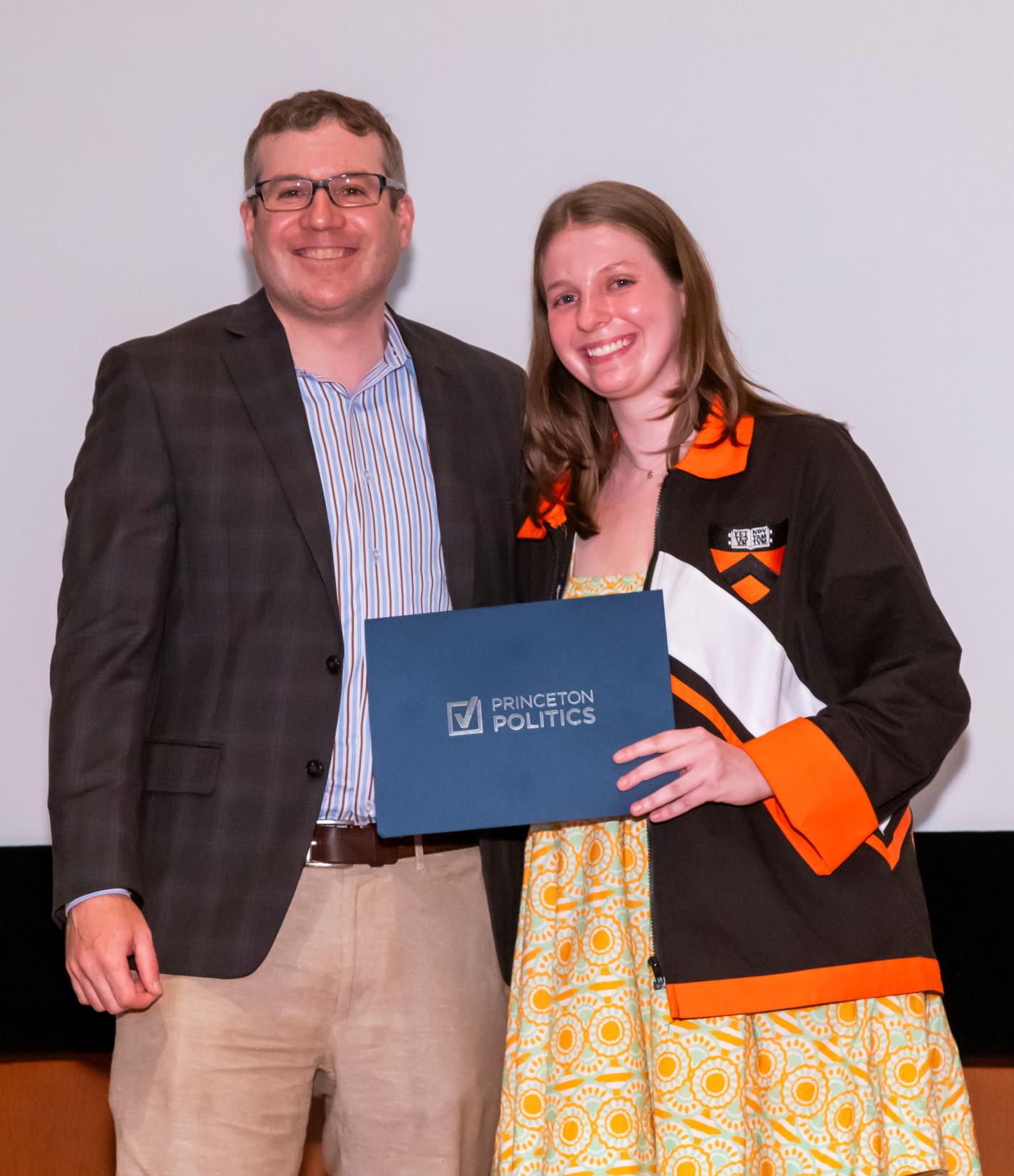
Professor Kastellec stands with award winning student.

The Junior Independent Work (JIW) requirement in Politics provides majors with an opportunity to delve into their research interests and conduct a thorough examination. The goal is for students to produce a well-reasoned and analytical essay that scrutinizes a political issue using approaches from political science. Over the course of two semesters, students are required to undertake two research projects, consisting of a research prospectus in the fall and a junior paper in the spring. The Department views these as “building blocks” toward the preparation of a strong senior thesis. 

POL 300 & the Fall Research Prospectus 

Important note: Politics majors are required take POL 300 (Conducting Independent Research in Political Science) in the Fall semester of junior year.

As part of POL 300’s course requirements, juniors will develop a research prospectus. The prospectus is normally 12-15 pages, and will include a description of the significance of the topic with references to the relevant literature and a detailed research design. The prospectus should define a significant political question or problem and outline a design for answering it through a process of systematic research. The research, may, depending on the nature of the topic selected, involve detailing the relevant primary and secondary literature or original documents, interviews, or compilation and analysis of existing or to-be-collected data.

The range of subjects suitable for a prospectus is wide. Most projects involve the following elements: (1) defining a significant question, (2) formulating a hypothesis, (3) detailing the relevant evidence and outlining how it can be assessed, (4) reviewing critically the work of others on this subject, (5) evaluating alternative methods of inquiry, (6) showing critical awareness of the limits of one’s projected arguments, and (7) prospectively relating one’s inquiry to a larger context of issues in political science. The prospectus is not a passive review of the existing literature, nor a summary of facts, nor a long editorial. It sets out the framework for conduct of a critical and creative analysis of a question, problem or issue. A framework that would allow for the development of a student’s own well-reasoned views, should the prospectus be carried out, is an essential part of this exercise. 

During POL 300 precepts, graduate student preceptors will work with students on developing their research prospectuses. The POL 300 precepts will include multiple opportunities for Politics juniors to present, discuss, and receive feedback on various components of their research design. Effective with the Class of 2028, the research prospectus will be the final assessment assignment in POL 300, and will be due during the time-slot designated by the Registrar's Office.

Spring Junior Paper

In the Spring semester, juniors complete a junior paper under the supervision of a Politics faculty member. [A directory of available Spring JP advisers can be found at the bottom of this webpage.] 

A junior paper (JP) written in the Department of Politics is normally 20-35 double-spaced pages and clearly focused on one politics-related question, problem, or issue. Junior papers are supposed to define a significant political question or problem and to answer it through a process of systematic research which may, depending on the nature of the topic selected, involve reading primary and secondary literature or original documents, interviewing or consulting archival materials, or compiling and analyzing statistical data of various forms. The range of subjects suitable for such essays is very wide. Most projects involve the following elements: defining a significant question, formulating a hypothesis, gathering and assessing evidence, reviewing critically the work of others on this subject, evaluating alternative methods of inquiry, critically reviewing one's own arguments, and relating one's findings and conclusions to a larger political context of issues. The junior paper is not a passive review of the existing literature, nor a summary of facts, nor a long editorial. It presents a critical and creative analysis of a question, problem or issue. A presentation of the student's own well-reasoned views is an essential part of this exercise. Policy recommendations are welcome but not required.

The rough draft deadline set by the Department for the JP is the Friday after Spring Break. Faculty advisers are expected to submit extensive comments on the written work of the students whom they advise. However, faculty advisers are under no obligation to give detailed comments on preliminary versions of the Spring JP if they are submitted after the Department deadline. 

In general, the standards defined for senior theses apply in faculty evaluations of the Spring JP, with the understanding that the time available to work on a Spring JP is much less than the time available for the senior thesis.

The completed Spring JP must be submitted into the Department of Politics junior independent work database by 4:00 pm on the day of the University’s stated deadlines for independent work as noted in our important dates. The Spring JP may not be submitted after the Politics deadline without the prior approval from the student’s Residential College Dean. If the student’s Residential College Dean, in conjunction with the Director of Undergraduate Studies, approves an extension with a late penalty, a late penalty of 1/3 of a letter grade for every 48 hours will be applied, beginning at 4:00 pm on the due date.

Students are encouraged to direct their Spring JP toward a possible thesis topic, and are allowed to use some of the same research for both. Nonetheless, the Spring JP must be an independent piece of work which stands on its own, and it may not be incorporated directly into the thesis. The Spring JP may expand upon ideas explored in the research prospectus. A student may draw on and cite their own prospectus just like they would use other resources. In addition, the student may re-use a limited portion of their prospectus in the Spring JP, including the literature review. Whenever material from the Fall research prospectus is re-used, the student must add a footnote noting the duplication. This policy does not affect the standard University guidelines for attributing ideas and research findings, whenever appropriate.

NOTE: Special permission is required to submit the same paper both for purposes of junior independent work and for a course. The Director of Undergraduate Studies and all instructors involved must give their consent in writing. This option is strongly disfavored, and permission will be given only in extremely exceptional circumstances. In cases where the course instructor is also the student’s junior adviser, it may be required that the paper be second-read by another faculty member of the Department.


  • Writing a JP: The Handbook (from the Writing Program)
  • Submission and Grading of Independent Work
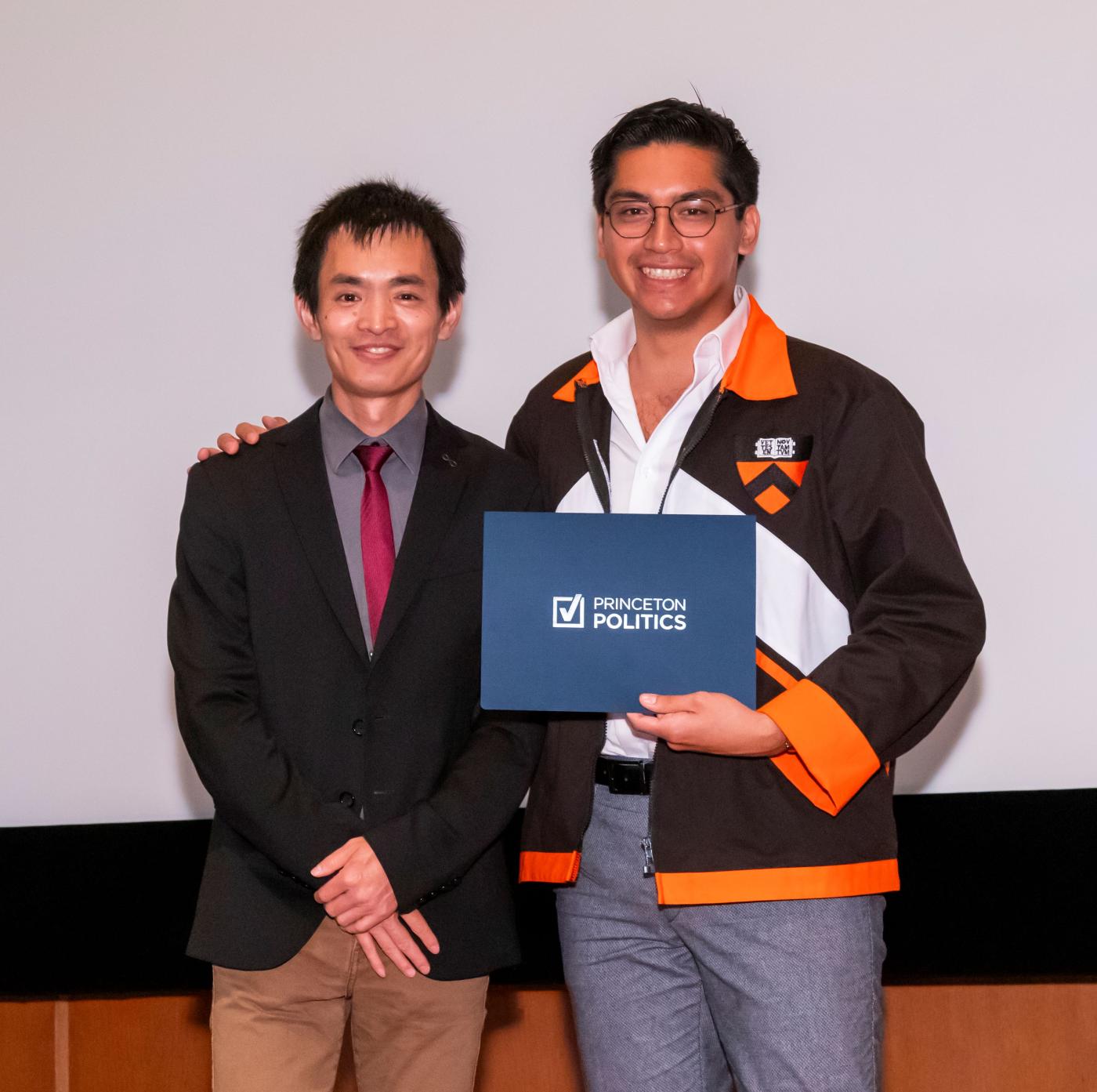
Professor Xu Xu stands with an award winning student

For the Classes of 2026 and 2027:  
Students will receive one POL 981 grade at the end of spring term that is a weighted average of fall (30%) and spring (70%) JIW grades. POL 981 will carry 2.0 units. Students must achieve a grade of C or better in POL 981. If a student receives a grade below C in POL 981, another Junior Paper is required with a grade that brings the average of this additional paper and the POL 981 grade to at least a grade of C. This is a prerequisite for beginning the senior year. 

For the Class of 2028 (and beyond):
Students will receive one POL 398 grade (replacing POL 981) which will be based 100% on the final version of the Spring JP. POL 398 will carry 1.0 unit. Students must achieve a grade of C or better in POL 398. If a student receives a grade below C in POL 398, another junior paper is required with a grade that brings the average of this additional paper and the POL 398 grade to at least a grade of C. This is a prerequisite for beginning the senior year. 

Spring JP Advisers 2025-2026

Advisers Fields of Study Areas of Expertise Advising Status
Carles Boix Comparative Politics, Political Economy Political Economy, Democracy, National Identity Formation Available
Gregory Conti Political Theory History of Political Thought, Democratic Theory, Representation, Freedom of Speech Full
Rafaela Dancygier Comparative Politics Extremism, Political Parties, Immigration, European Politics, American Politics Full
Aaron Friedberg International Relations International Security, Globalization, Political Economy, East Asia, Foreign and Defense Policy Available
Paul Frymer American Politics, Public Law, Race, Ethnicity and Identity American Political Institutions, Law, Parties and Organizations, Civil Rights and Race, Labor and Employment, Historical Institutionalism Full
Robert P. George Political Theory, Public Law Philosophy of Law, Constitutional Interpretation, Civil Liberties, Moral and Political Philosophy, Bioethics, Law and Religion, Natural Law Theory Available
Germán Gieczewski Formal Theory & Quantitative Methods, Political Economy Political Economy, Game Theory, Networks, Information Transmission Available
Naima Green-Riley International Relations Chinese Foreign Policy, U.S. Foreign Policy, Political Communication, Public Opinion Full
Dimitrios Halikias Political Theory History of Political Thought, Democratic Theory, American Political Thought, Capitalism, Socialism Available
Matías Iaryczower American Politics, Comparative Politics, Formal Theory & Quantitative Methods, Political Economy Political Economy, Institutions and Collective Decision-Making in Legislatures, Courts and Electorates Available
G. John Ikenberry International Relations International Relations Theory, U.S. Grand Strategy, International Organizations, International Order, Liberalism and International Relations Available
Marzenna James International Relations Case Study Methods, Economic Power in Central and Eastern Europe, Russian Foreign Policy Full
Gleason Judd Formal Theory & Quantitative Methods, Political Economy Political Economy, Elections, Lobbying, Legislative Bargaining Available
Ethan Kapstein International Relations International Political Economy, Economic Development, U.S. Foreign Policy, Conflict Full
John Kastellec American Politics, Public Law American Political Institutions, Judicial Politics, Supreme Court Nominations Full
Atul Kohli Comparative Politics Political Economy of Development, Politics in India, Imperialism and the Developing World Available
Nicholas Kuipers Comparative Politics Comparative Politics, Bureaucracy, Development, Southeast Asian Politics Full
Melissa Lane Political Theory Ancient Greek and Roman Political Thought, Athenian Democracy, Plato, Aristotle, Political Theory of Climate Change, Environmental Political Theory, Modern Political Thought Full
Frances Lee American Politics Congress, Political Parties, Policymaking Full
John B. Londregan International Relations, Formal Theory & Quantitative Methods South America, Political Economy, Electoral Politics, Text as Data Available
Nicholas Lotito International Relations International Security, Civil-Military Relations, Middle East and North Africa, Political Violence, Terrorism, Conflict, Democratization, Extremism Full
Stephen Macedo Political Theory Citizenship and Civic Education, The Constitution, Marriage and Family, Immigration, Diversity, Civil Liberties, Free Speech and Hate Speech Full
Corrine McConnaughy American Politics, Race, Ethnicity and Identity American Politics, Gender and Politics, Race, Ethnicity and Politics, American Political Development, Democratization, Social Movements and Protests, Policymaking, Social Identities, Federalism, State and Local Politics, Voting Rights, Political Decisionmaking Available
Andrew Moravcsik International Relations European Union Politics, International Relations Theory, Transatlantic Relations, International Human Rights, Qualitative Methods, International Organizations, International Law, Foreign Policy, Far-Right Populism, Global Democracy Available
Layna Mosley International Relations, Political Economy International Political Economy, Globalization, International Finance, Multinational Corporations, Global Supply Chains, International Trade, Sovereign Debt Full
Jan-Werner Müller Political Theory Democratic Theory, Constitutionalism, European Union, Politics and Religion Available
Elizabeth Nugent Comparative Politics Comparative Politics, Middle East and North Africa, Political Psychology, Authoritarianism, Politics and Religion Full
Temi Ogunye Political Theory Activism, Authority and Political Obligation, Civil Resistance, Social Norms, Political Theory, Social Change, Civil Disobedience Available
Grigore Pop-Eleches Comparative Politics Comparative Political Behavior, Authoritarian Politics, Historical Legacies, Eastern Europe and the Former Soviet Union, Latin America Available
Markus Prior American Politics Public Opinion, Political Involvement, Voting Behavior Full
Kristopher Ramsay International Relations, Formal Theory & Quantitative Methods, Political Economy Violent Conflict, War, Strategy, Political Economy, Environmental Politics Available
Jacob N. Shapiro International Relations Conflict, Political Economy, Security, Development, Technology Policy Full
Arthur Spirling Formal Theory & Quantitative Methods Comparative Politics, Political Methodology, Text as Data, Machine Learning/AI, Political Institutions, Parliaments, British Politics Available
Sarah Staszak American Politics, Public Law American Political Development, Bureaucratic Politics, Public Law Full
LaFleur Stephens-Dougan American Politics, Race, Ethnicity and Identity Racial Attitudes, Public Opinion, Black Politics, Race, Ethnicity and Politics, Political Communication, Experimental Methods Available
Rocío Titiunik Formal Theory & Quantitative Methods Quantitative Methods, Political Methodology, Applied Statistics, Comparative Politics, Party Systems Full
Rory Truex Comparative Politics Chinese Politics, Authoritarianism, Repression, Human Rights Available
Sam Van Noort Comparative Politics Comparative Politics, Political Economy, Democratization, Democratic Backsliding Available
James Raymond Vreeland Comparative Politics, International Relations International Political Economy, International Organizations, Democratization, Transparency Available
Leonard Wantchekon Comparative Politics, Formal Theory & Quantitative Methods, Political Economy Political Economy, Elections, Democratization, Governance Available
Ismail White American Politics, Race, Ethnicity and Identity Race, Ethnicity and Politics, Racial Attitudes, American Politics, Political Behavior, Public Opinion, African American Politics Available
Jennifer Widner Comparative Politics Public Management, State Capacity, International and Comparative Constitutional Law, Public Law, African Politics, Public Goods Provision, Politics of Reform, Disaster Response, Electoral Systems, U.S. Community Development Block Grant Program Available
Andreas Wiedemann Comparative Politics, Political Economy Political Economy, Economic Inequality, Social Policy, Representation Available
Lauren A. Wright American Politics Media and Politics, Executive Branch Politics and Policymaking, Public Opinion, Gender and Politics, Celebrity Politics Available
Xu Xu Comparative Politics, Political Economy Digital Authoritarianism, Repression, Chinese Politics, Political Economy of Development Available
Hye Young You American Politics Interest Groups, Lobbying, American Political Institutions, Political Economy, Congress, Bureaucracy, Federalism Full
Zeyang (Arthur) Yu Formal Theory & Quantitative Methods Causal Inference, Political Methodology, Political Institutions, Quantitative Methods, Comparative Politics, Chinese Politics, Political Economy of Development, Bureaucratic Organizations, Political Communication, Media and Politics Available
Noah Zucker Comparative Politics, International Relations, Race, Ethnicity and Identity, Political Economy Comparative Political Economy, Climate Change, Identity Politics, International Political Economy, International Organizations, Interest Groups Available
Princeton University
Department of Politics

001 Fisher Hall, Princeton, NJ 08544-1012 T (609) 258-4760 F (609) 258-1110

Accessibility Diversity & Non-Discrimination © 2026 The Trustees of Princeton University

Social Media

  • Bluesky
  • Instragram
  • X